Primary Care Network Deploys AI CDS Across 28 Clinics

A delayed diabetes diagnosis at Cypress Primary Care led to a family complaint and an internal review. The existing EMR-based clinical decision support was generating 38 alerts per encounter, and clinicians had largely stopped engaging with them.
Business Challenges
The complaint from the Robinson family arrived in March. Their 52-year-old family member, Daryl, had been receiving routine care at Cypress Primary Care every 18 months for nearly eight years. In February, he was hospitalized for diabetic ketoacidosis and remained admitted for six days. The family raised concerns about why earlier signs of diabetes had not been identified despite repeated visits and risk indicators.
The internal review found that clinical decision support alerts related to his condition had been triggered multiple times over the prior three years. However, clinicians were exposed to an average of 38 alerts per encounter across the system. This high volume led to widespread alert fatigue, and meaningful recommendations were frequently ignored. As Dr. Anna Holcomb, Medical Director, noted, the system generated compliance records but did not influence clinical behavior in practice.
Additional performance data showed broader issues. Guideline adherence across 12 USPSTF, ACC/AHA, and ADA measures averaged 68%. Approximately $340K in quality bonus payments remained unearned due to inconsistent measure documentation. Chronic disease management workflows for diabetes and hypertension were not consistently identifying and prioritizing high-risk patients. The CDS system was functioning technically, but it was not operationally effective.
- A delayed diabetes diagnosis triggered a family complaint and led to an internal review of CDS performance.
- Existing EMR CDS generated 38 alerts per encounter; alert fatigue led to missed clinical signals.
- Guideline adherence across key measures averaged 68%.
- ~$340K in annual quality bonus payments were not captured due to documentation gaps.
- Risk and preventive care signals were not consistently surfaced to clinicians at the right time.
Solution
The procurement process led by Dr. Holcomb focused on one core requirement: reducing alert volume to a level clinicians could realistically engage with. The target threshold was set at approximately 5 alerts per encounter.
eCareAssist’s clinical decision support platform was selected based on its alert suppression and prioritization model. Instead of triggering alerts based on static rule matching, the system evaluated clinical context, patient history, and prior provider interactions before generating notifications. This resulted in a significantly lower and more relevant alert set, with projected volumes in the 4–7 alerts per encounter range.
A second evaluation focus was clinical transparency and trust. Senior clinicians reviewed how guideline recommendations were sourced, updated, and documented. The platform’s ability to show recommendation logic and maintain clinical defensibility was a key factor in adoption, given prior dissatisfaction with legacy CDS tools.
Value Delivered
Within the first months of deployment, alert volumes stabilized at a significantly lower level, followed by gradual improvements in clinical adherence metrics as workflows adapted. By month nine, measurable improvements were observed across preventive and chronic care measures.
- Guideline adherence increased from 68% to 91% across 12 USPSTF, ACC/AHA, and ADA measures.
- Alert volume dropped from 38 to 5 per encounter; alert acknowledgment increased from 8% to 84%.
- $340K in annual quality bonus revenue was newly captured.
- HCC documentation improved by 22% through point-of-care prompts.
- Clinician relevance score reached 4.7/5, up from a baseline of 2.1.
Solution Provided
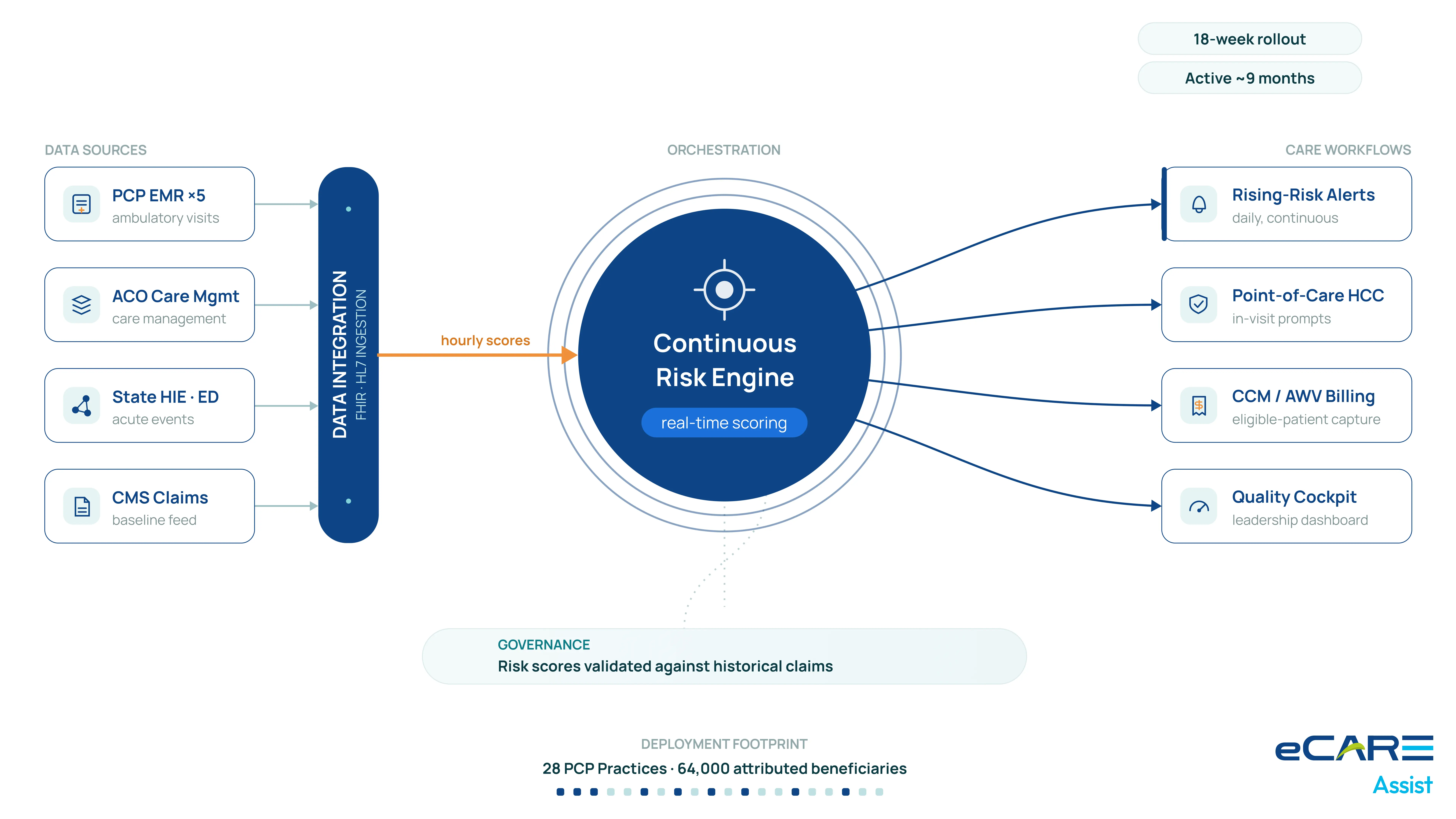
The implementation was completed over 13 weeks and was structured around clinician trust and workflow adoption rather than system deployment alone.
Weeks 1–3: Clinical Lead Co-Design
Clinical leaders and informatics teams reviewed all 12 quality measures and mapped them to real clinical workflows. The goal was to ensure CDS recommendations aligned with day-to-day practice patterns. Output included a validated configuration approved by clinical leads.
Weeks 4–6: Shadow Mode Across All Clinicians
The system ran in shadow mode across 22 clinicians. Alerts were generated but not shown to users. This phase was used to validate alert relevance and refine specificity before activation.
Weeks 6–8: Visible Mode at Three Pilot Clinicians
Three clinical leads tested the live system. Alert volume averaged 5.2 per encounter, meeting the defined usability threshold. Early feedback indicated improved relevance and reduced noise compared to the legacy system.
Weeks 8–11: Practice-Wide Activation
The remaining clinicians were onboarded in two waves. Alert volumes remained stable between 4–7 per encounter. Alert acknowledgment rates increased significantly, reaching 71% by week 11.
Weeks 11–13: HCC Documentation Workflow and Quality Cockpit
Point-of-care documentation prompts and a quality performance dashboard were introduced. HCC prompts supported documentation specificity during visits, while the cockpit provided real-time visibility into measure performance across the practice.
Business Value
Dr. Holcomb presented the 12-month results to Cypress’s board in spring 2026. The results were positioned as a shift in CDS from a passive alerting system to an active clinical support tool.
What changed about Cypress’s clinical risk posture
The Robinson family complaint led to a structural reassessment of clinical decision support use. CDS is now actively used in clinical workflows rather than being treated as a background compliance tool. High-risk signals are consistently surfaced and acted upon. The organization now views the system as part of its clinical safety infrastructure rather than a documentation layer.
The financial picture
The $340K in additional quality bonus revenue represents the direct financial impact. Improved HCC capture contributes approximately $620K in annual risk-adjustment revenue. Total recurring financial impact is approximately $960K against a $180K implementation cost. Leadership emphasized that patient safety improvements remain the primary value driver.
What changed about CDS as a discipline
Clinical decision support at Cypress has shifted from vendor-managed updates to clinically governed workflows. Clinical leaders now participate in quarterly reviews of recommendations and system logic. Updates to guidelines are reviewed and configured before deployment. CDS is now managed as a shared clinical-operations function between Cypress leadership and eCareAssist.
What Dr. Holcomb says publicly
“We had a CDS system that generated alerts, but it was not influencing clinical decisions in practice. Most alerts were ignored due to volume. The Robinson case made it clear that this was not sustainable. The system we implemented did not just replace the tool — it changed how CDS is used. It is now treated as part of clinical safety, not administrative compliance.”
— Dr. Anna Holcomb, Medical Director, Cypress Primary Care